✓ Third-Party Lab Tested
Certificate of Analysis
Independent laboratory testing confirms purity and composition of this research peptide.
Endo Passed
99.850% Purity
A1226 Batch
April 2026 Date
View Certificate →
Overview
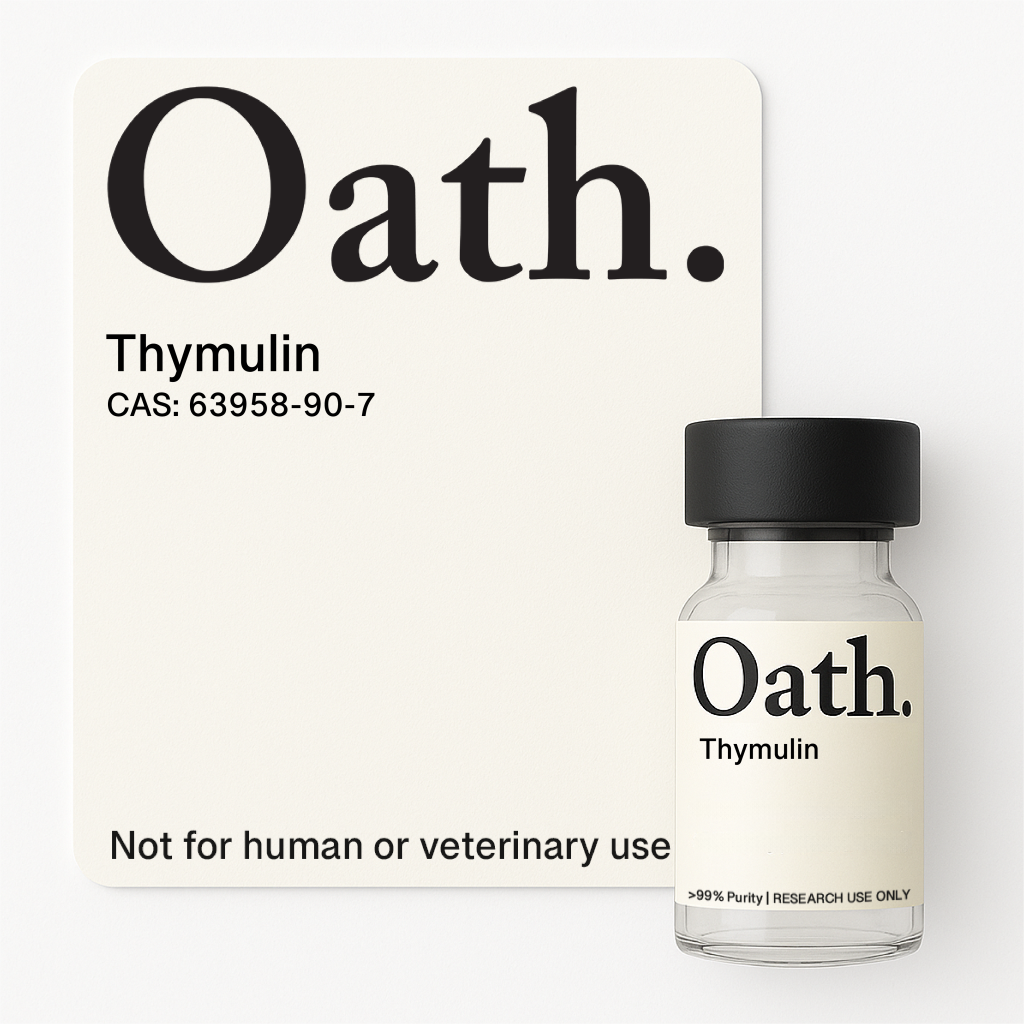
Thymulin is a nonapeptide — a chain of nine amino acids — with the sequence pyroglutamyl-alanyl-lysyl-seryl-glutaminyl-glycyl-glycyl-seryl-asparagine (Pyr-Ala-Lys-Ser-Gln-Gly-Gly-Ser-Asn). It was first isolated and characterized in 1977 from thymic epithelial cells in the thymus gland. Without its zinc cofactor, the peptide has a molecular weight of approximately 858 g/mol with the formula C₃₃H₅₄N₁₂O₁₅.
What distinguishes thymulin from other thymic peptides is that it requires a zinc ion (Zn²⁺) to adopt its characteristic three-dimensional fold. The zinc binds to specific residues in the peptide chain, and without it the molecule remains in an unfolded state. It is supplied as a white lyophilized powder, soluble in water, and should be stored refrigerated at 2–8 °C. This product is strictly for research purposes only.
PubChem Reference: View compound profile on NIH PubChem
This product is strictly for research purposes only. Not approved for human or animal use.
Key Characteristics
MOLECULAR PROFILE
Sequence: Pyr-Ala-Lys-Ser-Gln-Gly-Gly-Ser-Asn
Weight: 858 g/mol (without zinc)
Type: Nonapeptide (9 amino acids)
Origin: Thymic epithelial cells
PHYSICAL PROPERTIES
Form: White lyophilized powder
Solubility: Water soluble
Zinc Requirement: Essential for folding
Storage: Keep refrigerated 36‑46 °F (2‑8 °C)
A NOTE ON NAMING
Thymulin is widely sold across the research market under the name Thymalin. The two names refer to different things in the source literature: Thymalin is a Russian preparation consisting of a polypeptide extract of calf thymus, with no single defined structure, while thymulin is the chemically defined nonapeptide described on this page.
In practice, material supplied under either name in this market is the synthetic nonapeptide — published certificates of analysis for “Thymalin” consistently report a single species at approximately 858 Da, which is thymulin. We list it under both names because researchers search for both, and we would rather say so plainly than let the ambiguity stand.
This is the same compound we list as Thymalin. Ordering both will get you the same material twice.